
Florida Renters Insurance Rates Are Dropping: What Tenants Should Know Before Renewing
There is some encouraging news for Florida renters.
On October 2, 2026, the Florida Office of Insurance Regulation (OIR) announced that American Modern Home Insurance Company received approval for an average 12.8% rate decrease on HO-4 renters insurance policies, affecting approximately 121,898 exposures across the state.
The new rates became effective October 11, 2026, for new policies and renewals. In some Florida counties, the average reduction is even greater, including approximately 13.4% in Orange County and 13.8% in Broward County (Florida Office of Insurance Regulation, 2026).
That’s good news—but an important clarification is necessary.
This does not mean every renters insurance policy in Florida is dropping by 12.8%. The announcement applies specifically to American Modern Home Insurance Company’s HO-4 business. Your own premium will depend on your insurer, location, coverage limits and individual policy.
Still, the news creates a good opportunity for Florida tenants to ask a bigger question:
Do you actually know what your renters insurance protects?
At The Beacon Insurance Agency, we believe renewal shouldn’t simply be about checking the new price. It’s also an opportunity to make sure your coverage still fits your life.
Your landlord’s insurance doesn’t cover everything
One of the most common misconceptions among renters is that the landlord’s insurance protects everything inside the property.
It doesn’t.
The property owner’s insurance generally protects the building itself. Your furniture, clothing, computers, electronics and other personal belongings are your responsibility.
An HO-4 renters policy is designed specifically for tenants. In addition to protecting personal property against covered losses, it can provide personal liability coverage if you are legally responsible for an injury or damage to someone else’s property (Florida Office of Insurance Regulation, 2026).
So if a fire damages your apartment, for example, the landlord’s policy may address the building—but it shouldn’t be assumed that it will replace your television, furniture or clothing.
Renters insurance protects more than your belongings
Renters insurance is often described simply as coverage for your personal possessions, but a typical policy can provide several forms of protection.
The Florida Department of Financial Services explains that renters policies may include personal property coverage, loss of use, personal liability and medical payments to others (Florida Department of Financial Services, n.d.).
Loss of Use can be particularly important.
If a covered event makes your rental temporarily uninhabitable, this coverage may help with reasonable additional living expenses while you live somewhere else. Depending on the policy and circumstances, that could include additional costs for temporary accommodation, meals or other necessary expenses.
That is protection many tenants don’t think about until they suddenly need it.
Replacement Cost vs. Actual Cash Value can make a big difference
Here’s another detail worth checking at renewal.
Suppose your television, laptop and furniture are damaged in a covered fire.
How much would your policy actually pay to replace them?
With Actual Cash Value (ACV) coverage, depreciation is taken into account. An older item may therefore generate a substantially smaller payment than the cost of purchasing a similar new item today.
With Replacement Cost coverage, the policy can pay the cost of replacing covered property with an equivalent new item, subject to the terms, limits and deductible of the policy.
Florida DFS specifically recommends discussing this distinction with your insurance agent because both approaches are available and can produce very different claim outcomes.
A cheaper premium may look attractive, but understanding how your belongings would actually be valued after a loss is just as important.
What about expensive items?
Not every belonging receives unlimited protection.
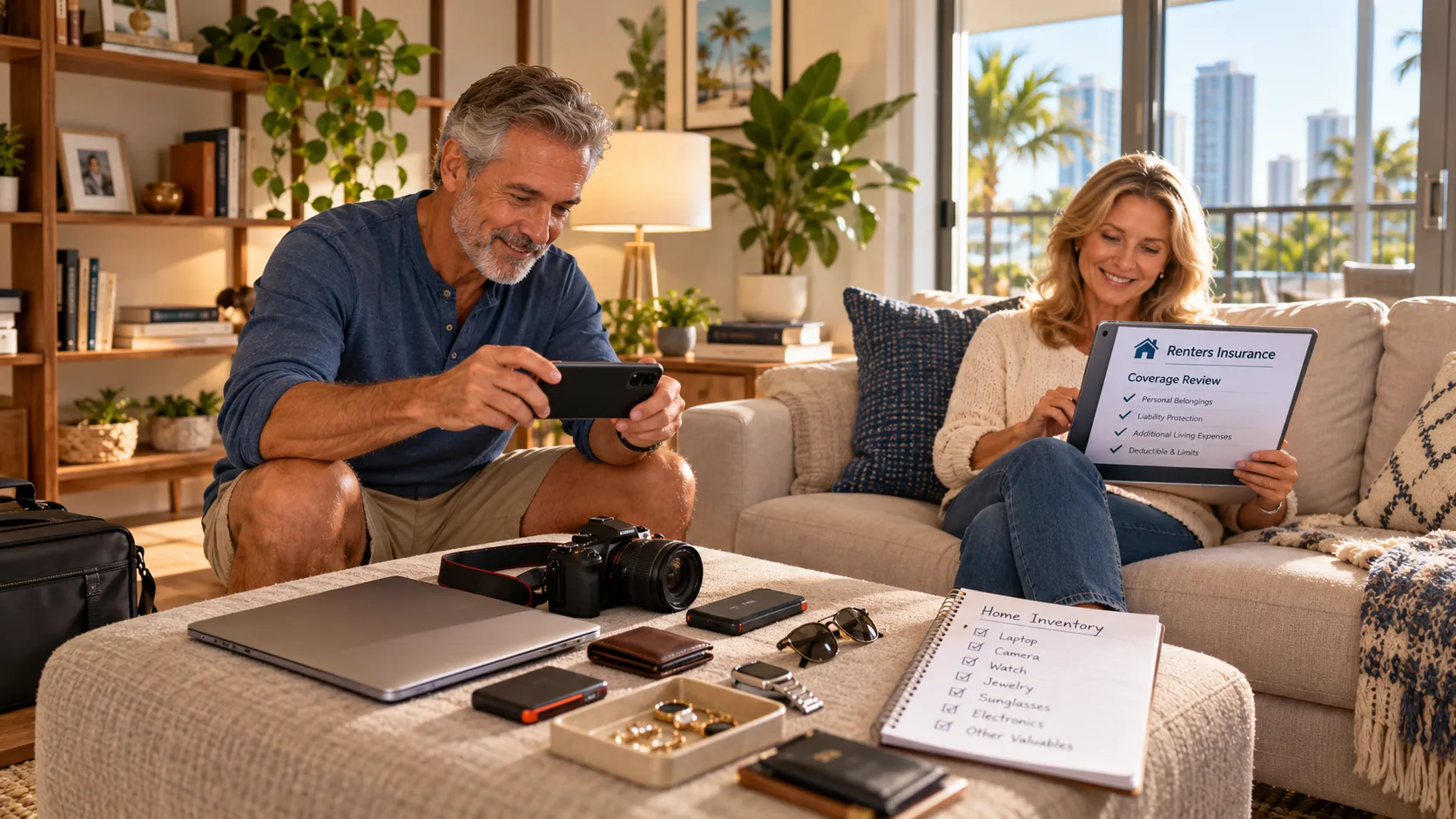
Renters policies can contain special limits for items such as jewelry, artwork, cameras, antiques, electronics and other valuable property. Florida DFS recommends reviewing these limits and considering additional coverage when necessary.
Think about what has changed since you purchased your policy.
Maybe you bought a new laptop, upgraded your home office, purchased expensive jewelry or added several high-value electronics.
Your existing personal property limit may no longer reflect what you actually own.
That’s why renewal is a good time to update your home inventory and make sure the amount of insurance still makes sense.
Don’t automatically assume flood is covered
This is especially important in Florida.
A standard renters policy should not automatically be assumed to cover flood damage.
Florida DFS explains that some insurers may offer flood protection through an endorsement. If your renters insurer does not offer that coverage, separate flood insurance for your personal belongings may be available.
Renters can also purchase contents-only flood coverage through available flood insurance markets, including the National Flood Insurance Program.
The important thing is to check before a flood occurs.
Living in a rental apartment instead of owning a house does not eliminate your flood exposure—or the financial value of everything you keep inside your home.
What should you review when your policy renews?
Instead of focusing only on whether the premium went up or down, take a few minutes to review four things:
✓ Your personal property limit: Would it realistically replace what you own today?
✓ Actual Cash Value or Replacement Cost: How would damaged belongings be valued?
✓ Liability and Loss of Use: Are the limits appropriate for your current situation?
✓ Flood and valuable items: Are there important gaps or special limits you should address?
Your individual premium can also vary based on factors such as location, amount of coverage, building construction, prior insurance history and other rating considerations used by the insurer (Florida Department of Financial Services, n.d.).
Lower rates are good news. Understanding your coverage is even better.
The recent Florida rate decrease is encouraging, particularly for affected American Modern Home policyholders.
But insurance should never be judged on price alone.
A renters policy can be relatively inexpensive compared with other types of insurance, yet it may protect thousands of dollars in personal belongings while also providing valuable liability and temporary living-expense protection.
At The Beacon Insurance Agency, we can help renters understand their current coverage, review available options and determine whether their policy still fits their needs as renewal approaches.
Because whether your premium is going up or coming down, the most important question is still the same: Will your coverage be there when you need it?
References
Florida Office of Insurance Regulation. (2026, October 2). Commissioner Mike Yaworsky Approves an Average -12.8% Rate Decrease for More Than 120,000 Rental Insurance Policies, Effective this Month.
Official source: https://floir.gov/newsroom/archives/item-details/2026/10/02/commissioner-mike-yaworsky-approves-an-average–12.8–rate-decrease-for-more-than-120-000-rental-insurance-policies–effective-this-month
Florida Department of Financial Services. (n.d.). Renters’ Insurance Overview.
Official source: https://www.myfloridacfo.com/division/consumers/understanding-insurance/renters-insurance
Florida Department of Financial Services, Office of the Insurance Consumer Advocate. (n.d.). Flood Insurance — Contents-Only Coverage for Renters.
Official source: https://myfloridacfo.com/division/ica/fullcoverage/flood